Facilitating the integration of essential technology components to ensure the performance, reliability, and industrialisation of your data processes.

Data performance is not measured solely by the relevance of the strategy pursued or the quality of the models deployed. It is measured by its ability to function as a coherent whole — which requires a cross-cutting perspective on challenges that are sometimes approached purely from a technical angle.
These three dimensions are inseparable: a well-chosen target architecture is worthless without controlled integration, and both will fail without stakeholder alignment.
We support you in this integration, whether it involves:
- Architecture and solution design
- Component integration and scaling
- Coordination between business, IT, and data teams
Illustration / Use Cases
Architecture and Solution Design
An industrial company established for several decades has a rich but fragmented data estate: multiple master systems coexist, while the legacy data warehouse remains primarily oriented towards BI and reporting. As part of its transition to AI, the challenge is to consolidate data and open access to new business use cases beyond traditional analytics.
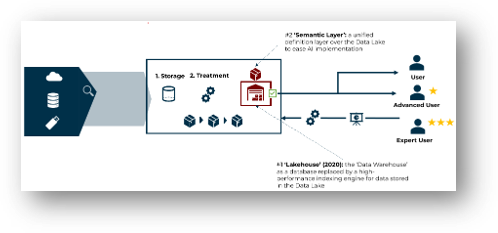
We support the architectural thinking and decision-making process with client teams — data lake or lakehouse, governance, data exposure, industrialisation of use cases. In practice, this means scoping workshops, a benchmark of options suited to the existing context, and modelling a target architecture consistent with the company’s AI ambitions. The goal: building a realistic roadmap, not an ideal architecture on paper.
Component Integration and Scaling
Once the target architecture is defined, the company must still choose between several implementation options: adopting a data fabric offered by a hyperscaler, an end-to-end integrated data platform, or a more modular and composable approach to preserve greater sovereignty and flexibility.
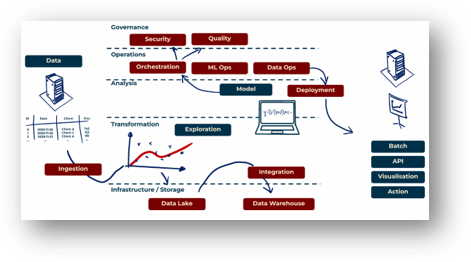
We support this selection phase by taking into account the existing context, constraints (organisation, skills, legacy systems, security) and AI ambitions. The goal is to structure component choices and define a pragmatic roadmap — balancing rapid industrialisation with complexity management — rather than defaulting to a vendor’s out-of-the-box decisions.
Coordination Between Business, IT, and Data Teams
The relevance of an AI programme rarely hinges on the technical dimension alone. Defining objectives, choosing the right metrics to optimise, and sequencing initiatives cannot be done without all stakeholders. In the case of predictive maintenance, this means for example deciding between probability of failure within a given time horizon versus a simple predicted failure date — a choice that involves data science, the business, and IT alike.
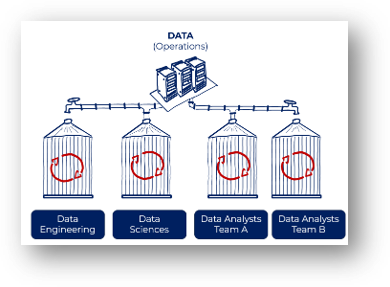
We help you clarify these choices and structure priorities to drive the overall success of AI programmes. The goal is to align stakeholders and roadmaps, rather than assuming that industrialisation will naturally follow business initiatives.