From Mecklembourg with love
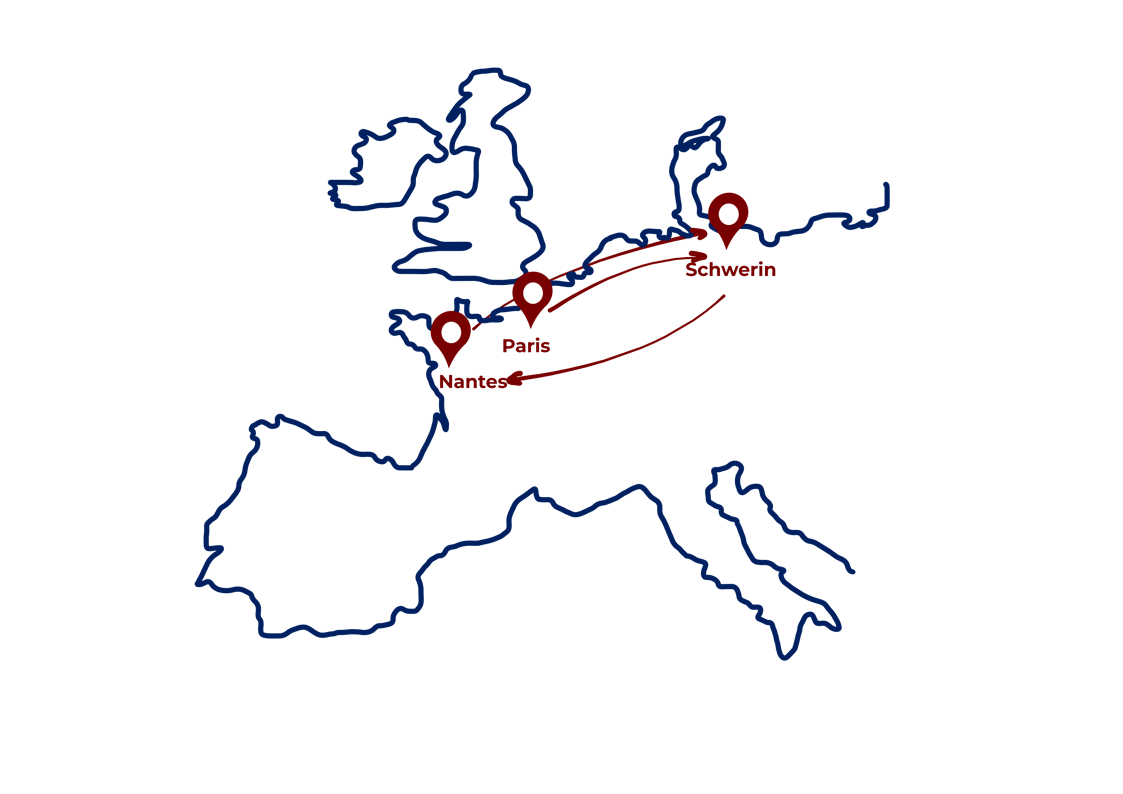
The more attentive will have guessed it — Meck’IT takes its name from the Mecklenburg region (Schwerin).
But behind this geographical nod lies a clear ambition: to continue a path started more than twenty years ago — one of excellence within a Franco-German environment.
The ups and downs of “fortuitous” encounters
The encounter with data was anything but linear.
It was shaped by a strong interest in modelling, nurtured at the École Normale Supérieure (rue d’Ulm) and the Paris School of Economics.
Then came a first turning point: joining the IT leadership of a large French group based in Germany.
This is where the link between statistics, information systems, and real-world applications became concrete.
The following years were dedicated to practicing data science across a variety of contexts: banking, industry, IoT, technical environments, and executive committees.
Meck’IT works !
This experience led to a simple conviction: data only has value when it is designed as a complete system.
This is the foundation of Meck’IT’s full-stack approach.
We always start from business meaning — what the organisation is truly trying to understand or decide.
We then co-build the entire data value chain:
- Infrastructure: how data is moved, stored, and made accessible
- Models: how it is structured, analysed, and turned into intelligence
- Governance: how it is secured, trusted, and shared
- Use cases: how it concretely transforms decision-making
This approach is not just technical integration. It is a way of connecting concept and execution without any break.
Based in a unique environment — between a UNESCO World Heritage city, a landscape conducive to reflection, and close proximity to major metropolitan areas such as Hamburg and Berlin — Meck’IT embraces a certain idea of work: demanding, structured, yet always grounded in reality.
Because this is where everything comes together.
Mastering data is not only about automating processes. It is about understanding a system as a whole, contextualising it, and building solutions that make decisions more accurate, reliable, and useful.