Build, test, and deploy models to enable prediction, detection, or explanation of a given phenomenon.

“All models are wrong, but some are useful” (George Box).
Data development engagements have one precise objective: building models that are useful.
Useful first in the concrete answer they provide to a key business problem: Can I anticipate equipment failures? (Predictive Maintenance) Is the process I’ve put in place being followed? Where are the bottlenecks? (Process Mining) How should I best organise my restocking? (Optimisation) How can I identify weak points in my network? (Vibration Analysis), etc.
Useful in the sense of actually being used — meaning correctly deployed and integrated into the existing software ecosystem.
Depending on where you stand in this chain, we intervene on a specific segment or across the entire full stack, that is:
- Modelling (from data cleaning to pattern detection).
- Deployment
- Industrialisation and observability
- Spreading data development best practices.
Illustration / Use Cases
Modelling
An organisation is facing a recurring problem it currently cannot solve (supply shortages, repeated similar failures, processes that consistently run late, higher-than-average turnover, etc.). It has data — or could have it — and wants a precise answer to this problem.
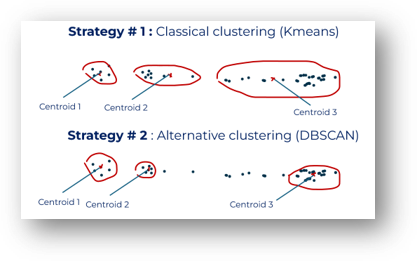
We guide you through every step of the modelling process — from data collection and cleaning to fine-grained evaluation of model results. Beyond the answer itself, we help you understand the underlying statistical reasoning: why should you avoid a given model in this context? How do you ensure predictions generalise well? Are you truly confident in what you’re seeing?
Deployment
An organisation has data scientists capable of developing and selecting relevant models. However, relationships with other departments are complex (tooling, SLA, production environments) and models struggle to make it out of the notebook.
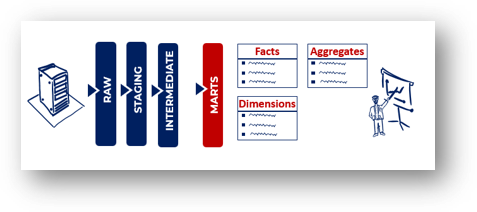
We help you put in place a robust and reproducible deployment workflow — whether for real-time or batch inference — drawing on industry standards (model versioning, drift monitoring, CI/CD pipelines). The goal: turning what is hand-crafted into configuration that is steerable and maintainable by the team.
Spreading Best Practices
We also support your teams in collaborating and communicating more effectively, by aligning the expectations and habits of each department.
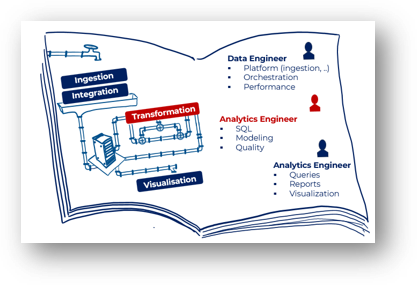
While the data engineer thinks about pipeline scalability, the data analyst thinks about edge cases tied to a business subtlety in metric definitions, and the data scientist thinks about the statistical significance of an often-imperfect calculation (and one could add to the picture the platform engineer, the DevOps engineer, etc.). So many departments with their own priorities, roadmaps, and concerns. We step in through workshops, cross-team code reviews, and inter-team pair programming to break down these silos and align practices around a shared foundation.